This is great news! I’ll be based in Berlin at the Humboldt Institute for Internet and Society (HIIG) in April and May 2018!!! yay!
As part of this research stay Christian Katzenbach and I are organizing a workshop on the role of future imaginaries in the making and governing of digital technology. It will take place on 27 April 2018 at the HIIG in Berlin. We are really happy that Sally Wyatt (Maastricht University) will hold a keynote!!
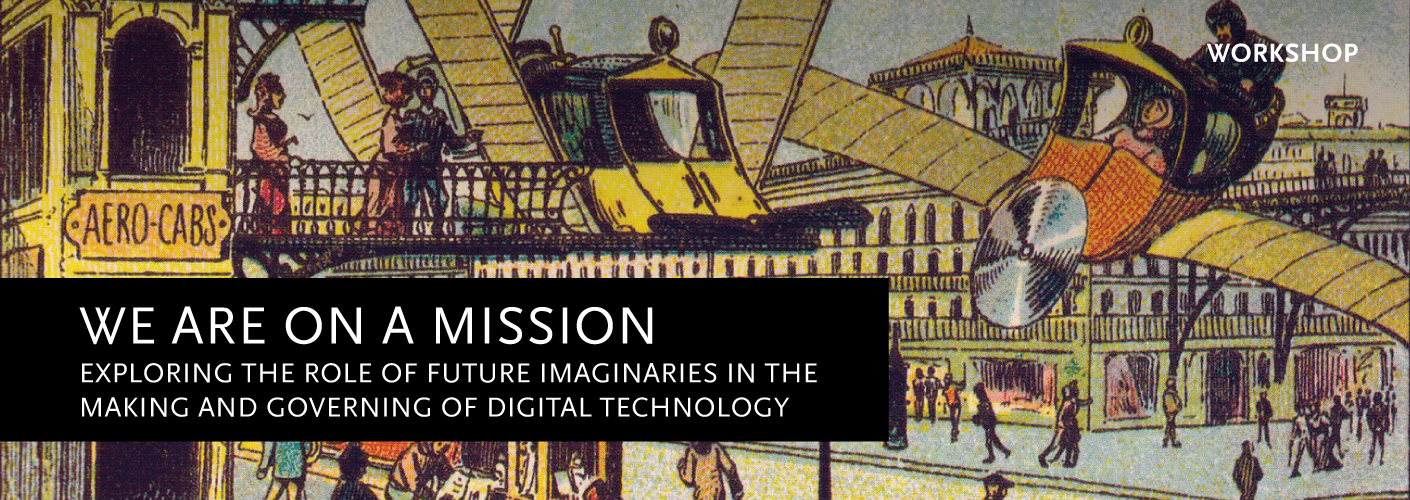 See further details of the workshop here. If you’d like to participate in the workshop, please send an english language abstract (300-500 words) until 2 March 2018 (beware of the tight deadline!!!). We encourage you to also submit work-in-progress.
Please contact me if you have further questions! We’re looking forward to your contributions!
Here’s the full CfP:
“We are on a mission”. Exploring the role of future imaginaries in the making and governing of digital technology
Call for Abstracts
Deadline: 02.03.2018
Workshop
Friday, 27 April 2018
Alexander von Humboldt Institute for Internet and Society
Französische Straße 9,
10117 Berlin, Germany
Keynote: Sally Wyatt (Maastricht University)
“We are on a mission to build a more open, accessible, and fair financial future, one piece of software at a time” promises the software platform Blockchain. “Imagine if everyone could get around easily and safely, without tired, drunk or distracted driving” envisions the self-driving car company Waymo (a subsidiary of Google’s parent company, Alphabet Inc.). “The Regulation is an essential step to strengthen citizens’ fundamental rights in the digital age and facilitate business by simplifying rules for companies in the Digital Single Market” claims the European Commission with regard to the General Data Protection Regulation.
These examples show how imaginaries of future societies are enacted to promote digital innovations or legitimate certain modes of internet governance. They illustrate how software providers, tech companies and legislators dig into the rich pool of cultural norms, visions and values to support (or question) digital tools, rules and regulations. Future prospects seem to be central for making decisions in the present.
What role do future imaginaries perform in the making and governing of present digital technology? How are they mobilised to push or oppose digital innovations such as artificial intelligence, the internet of things, blockchain technology or open source/open data projects? How are prospective imaginaries shaped in policy discourses and governance practices regarding networked technology and global data flows? What significance do European specificities have in global technology imaginations? Can different mechanisms be identified in mainstream discourses and counter-narratives? What happens if future scenarios are contested and digital promises become contradictory?
Themes of the Workshop
These are central questions to be discussed in our workshop. We welcome theoretical, methodological and empirical contributions that help us understand how the future is mobilized to make and govern digital technology in the present.
The workshop is organized around three central themes:
- Theories and concepts to analytically grasp future visions and their roles in the making and governance of digital technology
- Methods and tools to analyze the nexus between future imaginations and their functions in and impact on policy-making and technology development
- Empirical research and case studies on future imaginaries and their roles in the making and governing of present digital technology
Submission
We welcome theoretical, methodological and empirical contributions from various disciplines that speak to the themes of the workshop. Please send an english language 300–500 word abstract including title that describes your contribution to the workshop. We encourage you to submit work-in-progress.
Abstracts are submitted via e-mail to astrid.mager@oeaw.ac.at before 2 March 2018. We will send out notifications on 13 March 2018.
Organisers
Astrid Mager
Institute of Technology Assessment (ITA), Austrian Academy of Sciences
Elise Richter Fellow, Austrian Science Fund (FWF), project no. V511-G29
astrid.mager@oeaw.ac.at
Christian Katzenbach
Alexander von Humboldt Institute for Internet and Society
katzenbach@hiig.de