biofuels in public spheres

Tomorrow I’ll be giving a seminar talk together with Jenny Eklöf from Umeå Studies in Science, Technology and Environment (USSTE). The title is “BIOFUELS IN PUBLIC SPHERES: How old and new media shape the biofuel controversy under the influence of technoscientific marketing”. All Umeå people are very welcome!!!

November 8, B 203, 13:00-14.30; Abstract:

While biofuels have been celebrated as an eco-friendly alternative to petrol with the potential to slow down climate change in the past, they have come under scrutiny due to their environmental and social impacts more recently. This seminar talk discusses our ongoing research project on the biofuel controversy in public spheres. The main research question to be addressed is how the controversy plays out in the Swedish press and in (Swedish) search engine results. Using “classical” (content analysis) and “digital” methods (search engine queries, link network analysis, issue clouds) we aim to show who the dominant actors are in both spheres, what visibility strategies they employ, and how actors from different sectors (industry, policy, academia) merge. In this analysis we specifically focus on blurring boundaries between different types of information (scientific, journalistic, activist, commercial etc.) and the way strategies of “technoscientific marketing” influence the staging of the controversy in the media and search engine results. This case study enables us to draw conclusions on how actors’ visibility strategies and different media (and their underlying mechanisms and business models) work in tandem to create blurred knowledge boundaries/ processes of information commercialization.

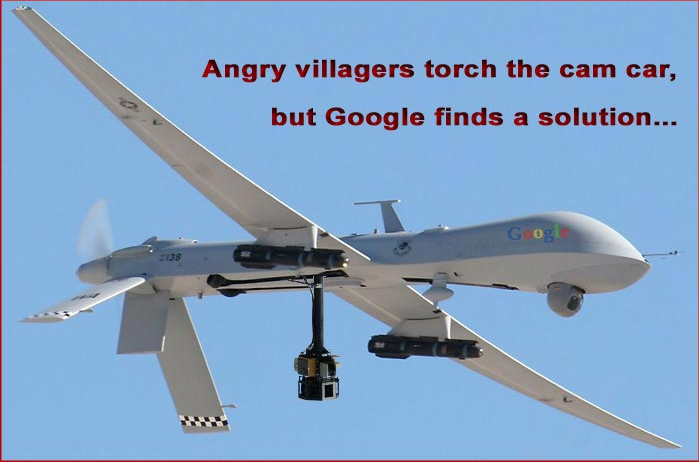
image credit © http://thecostaricanews.com/

Internet & Society/ Berlin

The second event I attended, just last week, was the Inauguration Symposium of the “Alexander von Humboldt Institute for Internet and Society” – also referred to as the Google Institute or Google-financed Institute (see its mission statement here). Even though I was a little skeptical at first, given the fact that Google sponsored both the Institute and the event, I greatly enjoyed the symposium! The first thing I realized when checking in was that a lot of technology would be involved in the conference.
The most stunning piece of technology was table cards with our names on them, but also QR codes identifying our profiles (we all had set up before going to Berlin). Whenever someone from the audience wanted to contribute something the QR code was scanned and the profile of the person was displayed on a screen (guess Patrik Svensson, director of HUMlab, would have loved this!). Right next to this screen was an even bigger screen showing the slides and an extended flip chart with a piece of paper on it – this was used to keep track of each session with a visualization, a picture summarizing the topics dealt with in the session (created by highly skilled illustrators!!). Moreover, there was a Google doc that collected notes and thoughts on the presentations, referees, and discussions. Given all this available documentation/ information a blog post on the issues treated at the conference seems to be almost obsolete.
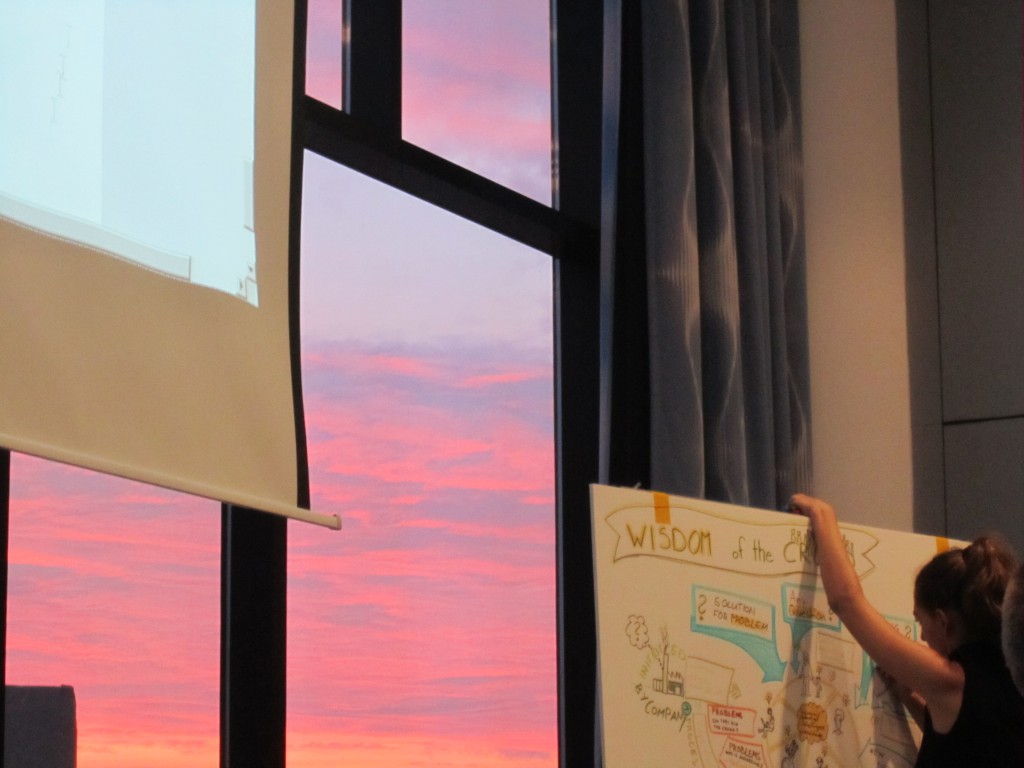
That is why I’d like to share some unsystematic thoughts rather than a systematic summary of the conference (also because I missed parts of it). Altogether I think the four directors – Dr. Jeanette Hofmann, Prof. Ingolf Pernice, Prof. Thomas Schildhauer and Dr. Wolfgang Schulz -, together with the organizers, managed to put together a dense program with great speakers (especially on this short notice). I liked the workshop-oriented approach, even if it partly turned out to be more of an academic conference, than an interdisciplinary workshop. The combination of presentations and respondents worked out well and the chairs did a great job in general. My personal highlights were the sessions “Wisdom and Power of the Crowds“, especially Malte Ziewitz’s contribution on crowd wisdom and regulation, and “Dwelling in the Web: Towards a Googlization of Space” with contributions from Florian Fischer, Lonneke van der Velden, Robert Vogler, Tristan Thielmann; commented by Richard Rogers and others.
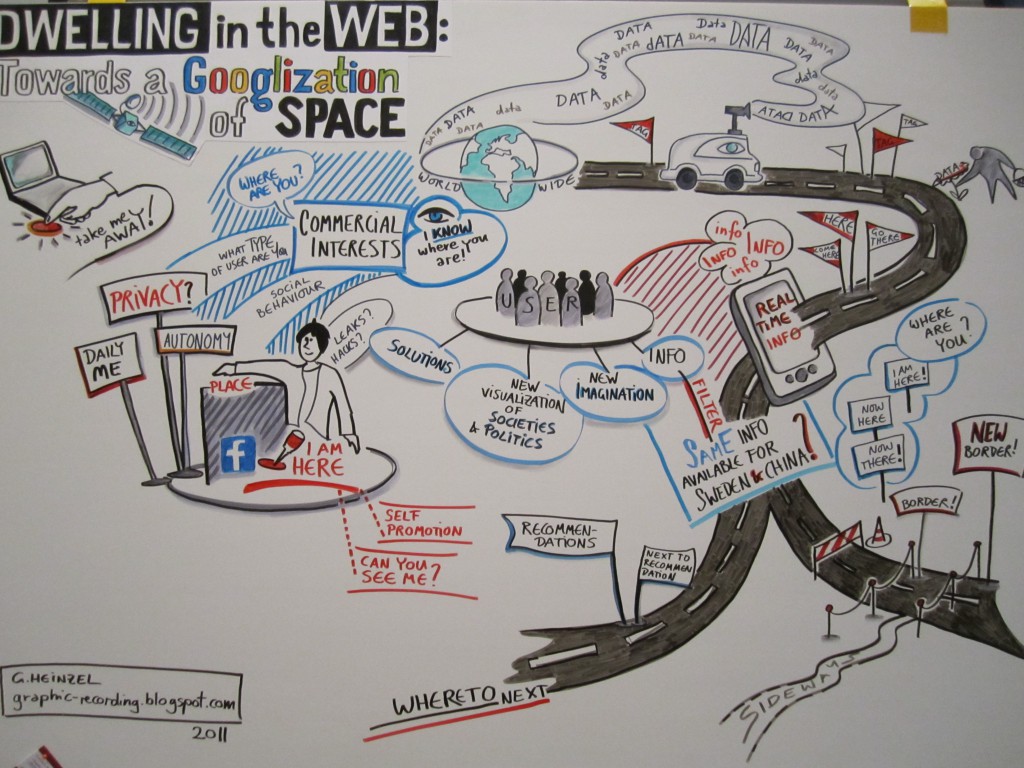
In the latter session the role of Max Senges, working in Google’s policy team and mediating between the new Institute and Google, as it seemed to me, attracted my attention. Whenever criticism of  Google was raised (e.g. its policy of border drawing in regions such as Tibet) Max Senges started to defend Google, which I found interesting and made me wonder what the overall agenda may be that Google followed with funding the Institute (an aspect that is still not entirely clear to me, but will only get clearer in the upcoming years, I guess). In this context an interesting question was raised by Senges at the very end of the symposium: How could the Institute and its research be evaluated beyond classical academic impact factors? (This question is not easy to answer, of course, but Cornelius Puschmann put up some interesting thoughts for discussion in his recent blog post)
The format of the last day was a little challenging. The idea was to have round table discussions in small groups debating/ reflecting results from the first two days together with stakeholders, who might not have been part of the symposium. Since the schedule was really tight this didn’t turn out so well, I thought. I thus decided to attended a workshop, where Cornelius and David Pachali presented the online platform (to-be) Regulation Watch and discussed it with the workshop participants to figure out what such a platform could/ should provide and who might contribute/ and why – which was fun. Besides the academic insights I got, I appreciated the really good food, drinks and, of course, the boat trip through Berlin by night, one of the highlights I got to experience together with Katrin Weller, René König, and others 🙂

And, last but not least, I loved to be back in Berlin, which is a truly great and vibrant city. Thanks to Axel Volmar for letting me stay at his place again, in lovely Kreuzberg!
If you got interested in the event more information could be found online: First, all the draft papers created for each of the sessions organized along the four directors and their topical foci. (The Google docs created at the conference and summarizing all workshops are only accessible to participants of the conference unfortunately). Second, blog posts on selected sessions, e.g. by Axel Bruns (SnurBlog), Judith Schossböck (Digital Goverment & Society) or Cornelius Puschmann ( Blog). Third, the visual representations of the sessions provided by Esteban Romero-Frías on his blog. And, finally, a link to the videos of the keynotes of the four directors and Eric Schmidt’s contribution.

Knowledge machines between freedom and control/ Hainburg

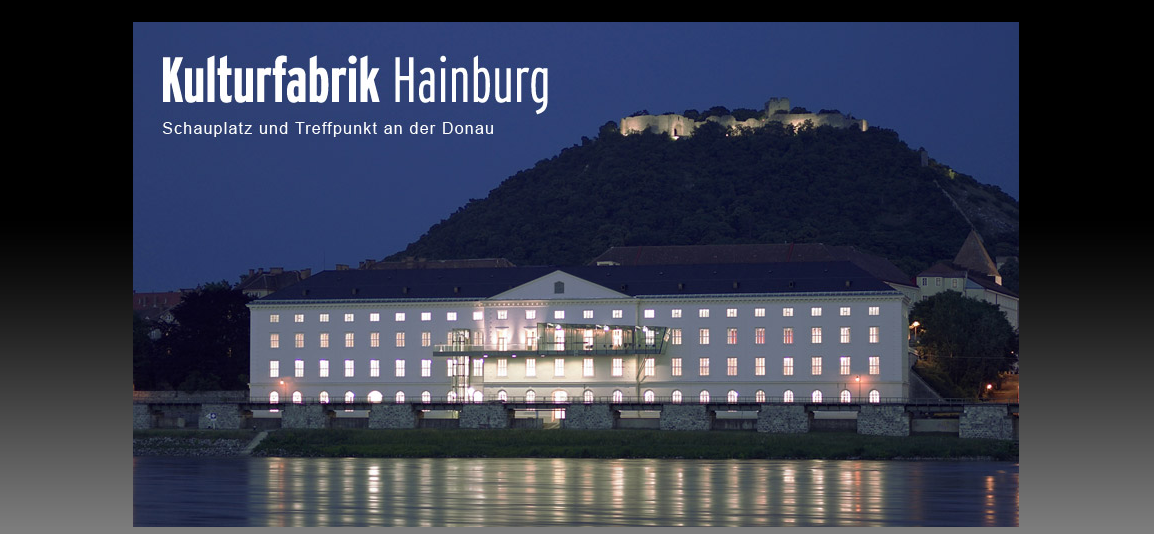
I’ve attended two great events in October. The first one was a symposium organized by the Institute of Media Archeology (IMA) and Theo Röhle, author of the book “Der Google Komplex. Über Macht im Zeitalter des Internets“. The symposium/ workshop took place in the beautiful Kulturfabrik in Hainburg.

© Kulturfabrik Hainburg

The idea of the event “Knowledge machines between freedom and control” was to bring together researchers, artists and programmers dealing with search engines and new media in a more general sense. I really enjoyed working together with artists and net activists, who have both similar and different viewpoints on the matter. Accordingly, on the first day, we tried to identify our positions on the issue, discuss possibilities and challenges in terms of search engine developments, think about utopias, but also concrete policy actions and implementations. In my workshop group the focus was on user profiling, personalization of search results, user data collections, or our “data bodies”, and their implications. While we easily found various issues to criticize (the filter bubble and privacy issues first and formost), we – or at least I – had trouble developing utopias or thinking outside the present socio-political contexts and structures. Hence, we ended up writing a manifesto on our data bodies, which I found liberating and fun! (thanks to Theo for putting this up). Thinking outside of the box and outside of academic requirements leads to pretty interesting results sometimes! Hence, the combination of researchers, artists and programmers really worked out in terms of having triggered creative ideas, writings and drawings, that wouldn’t have popped up in a merely academic arena.

The second day was meant to be a public event, the public, however, was sort of limited unfortunately. We presented and discussed our workshop results along the lines “index”, “algorithm” and “profile”. Finally, we had a round table discussion. Konrad Becker started out with a critical comment, which was followed by a lively debate on Google and Facebook, monopoly formation, alternative indexes and technology, business models, societal implications and potential futures regarding our knowledge machines and their relation to society and business. Moreover, the art piece “Insight Tower – A world machine” enabled us to stick our heads into the net – a piece by Seppo Gründler, Nicole Pruckermayr, and Elisabeth Schimana. In my viewpoint, it was a truly successful event! I especially liked meeting Theo Röhle, Malte Ziewitz, and Katja Mayer again, who all work at the intersection of search engines and science and technology studies. Moreover, I met really cool people like Seda Gürses doing research on social networks and (EU) policy making, and Joris van Hoboken working on search engines and law/ freedom of expression, as well as the media artist Nicole Pruckermayr and the musician/ performer Reni Hofmüller. And, last but not least, the artist/ performer Elisabeth Schimana, who organized the event and does a great job of leading the IMA . Thanks a lot for putting together this amazing crowd of people and ideas!!

network theory

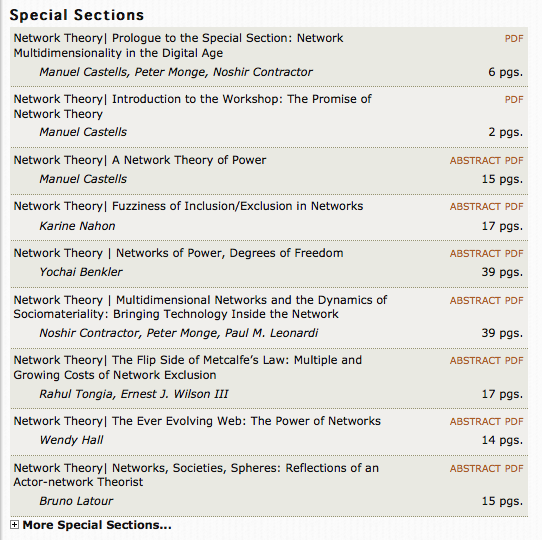
The International Journal of Communication (an online, multi-media, academic journal with peer-review process) has a special issue on Network Theory, which looks highly interesting! All articles are available online and free to access 🙂 Here’s the table of contents (2011, Vol. 50):

?

found in the woods..


oii conference “a decade in internet time”

I highly enjoyed the OII conference in Oxford over the last couple of days! Even though I don’t have enough time to write a proper blogpost about the conference I’d like to share some of my personal highlights. First of all, I really enjoyed seeing Manuel Castells speaking live for the first time! Since I’m a big fan of his writings I was glad to see that he’s not only a thorough thinker, but also an excellent speaker (the two not always necessarily go together). He was talking as part of the anniversary plenary session, which further included Vint Cerf, Wendy Hall, Eli Noam, Andrew Graham – all of them gave a great speech about the last decade of Internet research and future perspectives and challenges.

Besides this distinguished panel there were more events worth metioning. My own panel “Ethics & Values”, for example, was well assembled. Particularly Vicki Nash’s talk “Dissenting Values at the Heart of the Internet” turned out to be really useful in terms of my future research. Also, I enjoyed the discussion that followed my talk, even though it was brief because I was the last speaker in the session, which was bad as usual.. 😉

Further, I liked the panel on “Virtual Knowledge” with Sally Wyatt, Paul Wouters, Smiljana Antonijevic and others from the Virtual Knowledge Studio, which triggered the question whether this conference could have happened 10 years ago or whether new media, Twitter in particular, fundamentally changed the way knowledge is created, shared and distributed. Also, Alberto Pepe’s talk “Identity Dilemmas on Facebook” was really clever and well done. He re-enacted Pirandello’s novel “One, no one and one hundred thousand” in the Facebook age. Finally, Laura De Nardis’ talk “Technologies of Dissent” made a huge impression on me. She gave an in-depth analysis of Internet governance as socio-political practice in a global (capitalist) age. After Aleks Krotoski’s comments an interesting discussion evolved around Internet governance and the role governments, but also – and even more importantly – corporate actors such as Google play therein. I ordered De Nardis’ book “Protocol Politics” immediately after the session.

And then, last but not least, I perceived Oxford itself as a very enjoyable town. Thanks to Alberto Pepe, Jean-Christophe Platin, Juliette De Maeyer (sorry for having missed both of your presentations – shame on me!!) for their nice company, and Malte Ziewitz, who showed me his college at night.. pretty spooky! Thanks for that and see you in Hainburg soon! 🙂

For those of you who missed the conference: most of the papers are online here.

Upcoming travels and events

Tomorrow morning I’ll go to Oxford to participate in the OII conference “A Decade in Internet Time“. The line-up of speakers looks very promising and includes big names such as Manuel Castells, Ted Nelson, Danah Boyd, and others. I’m looking forward to present and discuss my paper “Algorithmic Ideology” in this great intellectual enviroment. That’s the abstract of my talk:

This article investigates how the “new spirit of capitalism” (Boltanski & Chiapello, 2007) gets inscribed in the fabric of search algorithms by way of social practices. Drawing on the tradition of the social construction of technology (SCOT) and 17 qualitative expert interviews I discuss how search engines and their “capital accumulation cycle” (Fuchs, forthcoming) are negotiated and stabilized in a network of actors and interests, website providers and users first and foremost. I further show how corporate search engines and their capitalist ideology are solidified in a socio-political context characterized by a techno-euphoric climate of innovation and a politics of privatization. This analysis provides a valuable contribution to contemporary search engine critique mainly focusing on search engines’ business models and societal implications. It shows that a shift of perspective is needed from impacts search engines have on society towards social practices and power relations involved in the construction of search engines to reconsider and renegotiate search engines and their algorithmic ideology in the future.

The full paper could be downloaded here. After the OII conference I’ll take part in the workshop Social Media Cultures, which will take place at HUMlab right after (26-28 September). It’s a joint workshop of researches from the Umeå University and the University of Wollongong/ Australia. Thanks to Jim Barrett for organizing this event!

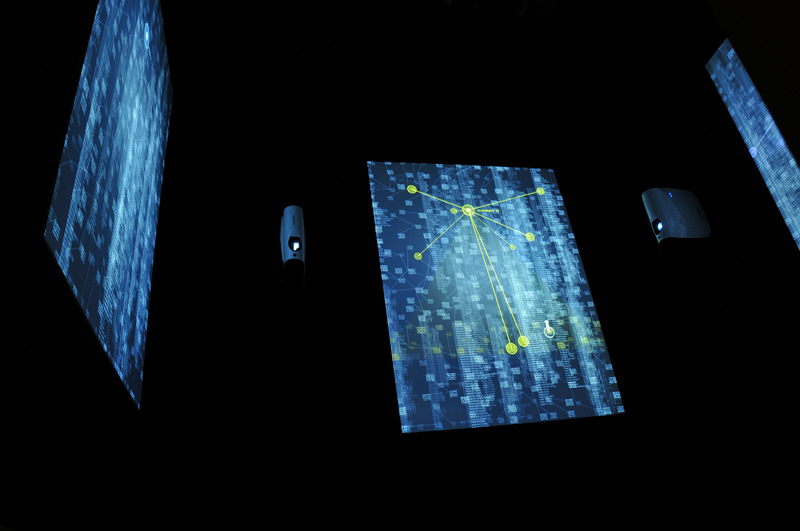
On the 5th of October I’ll go back to Austria to join the symposium “Knowledge Machines between Freedom and Control” in Hainburg, which is organized by IMA, Institut for Media Archeology, in cooperation with Theo Röhle. It’s the final event of the exhibition “insight-Tower – A World Machine“, where you can “stick your head into the net” (concept: Seppo Gründler, Nicole Pruckermayr, Elisabeth Schimana, Martin Schitter):

© photo credit IMA

The symposium aims at initiating a discourse on search engines between researchers, technicians and artists and closes with a public event, which seems exciting to me! From Vienna I’ll  most probably go to the inauguration symposium of the new research institute “Internet and Society” in Berlin (25-28 October). Since the institute is financed by Google and renowed German Universities have started to collaborate with them I expect it to be a truly interesting conference/ workshop (some of the details are still fuzzy though).

Finally, in November, I’ve been invited to participate in the workshop “Studying digital cultures – tools and methods for Humanities scholars” in Lund; organized by Lund University’s Humanities Laboratory, the Humanities Experiment Group (HEX), and the Department of Arts and Cultural Sciences (24 November). I’m already looking forward to seeing Jutta Haider, Olof Sundin & Karolina Lindh again, who made my last stay in “the south of Sweden” incredibly enjoyable!! Finally, in December, there will be another HUMlab conference called “The Internet of Things”, more infos will follow!

In between all these exciting events I hope I’ll get some writing done, another grant proposal out, and to pursue my research project on the biofuel controversy in Swedish media and search engine results (together with Jenny Eklöf), a project I’m really looking forward to!! 🙂 We’ll present our work at the beginning of November as part of the Umeå Studies in Science, Technology and Environment seminar series. Stay tuned!

goodtosee #9: Scroogle

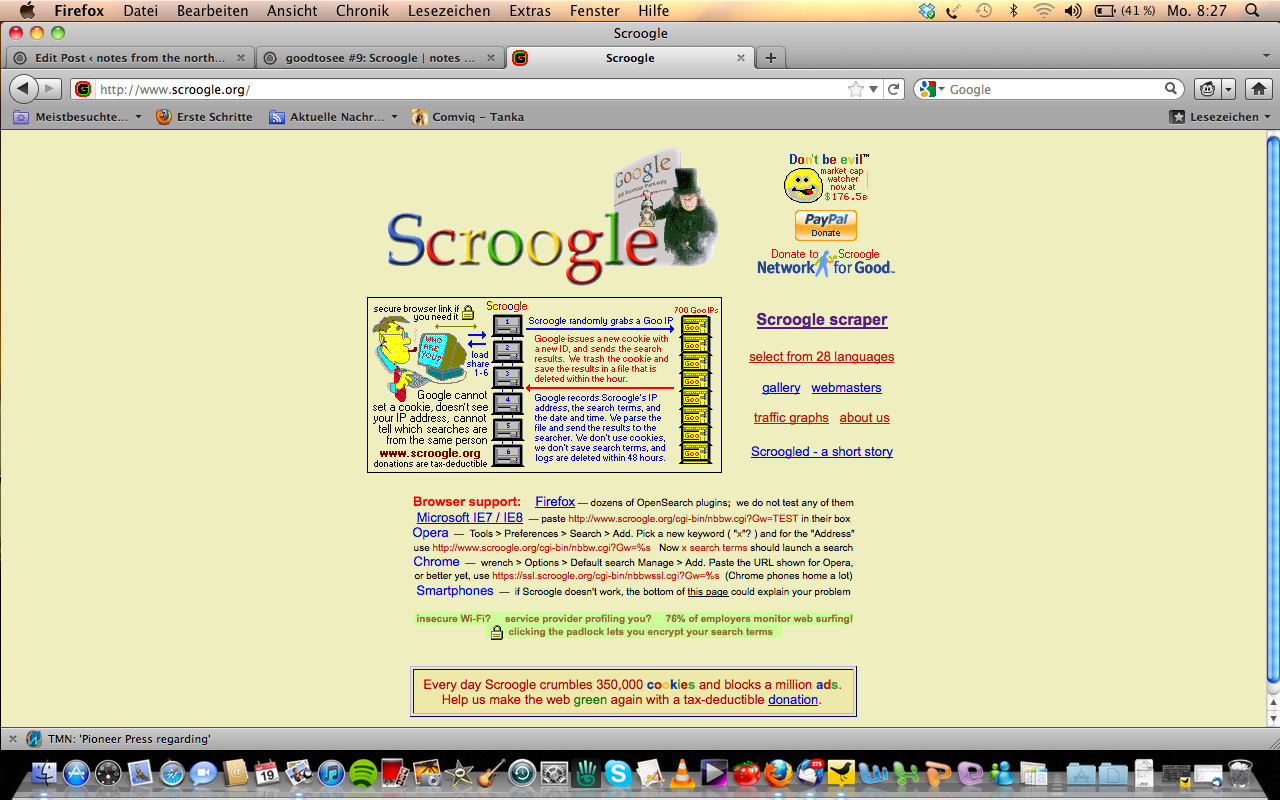
I briefly talked about Scroogle in a previous blogpost, but it deserves its own post since it’s such a great tool! Scroogle was developed by Daniel Brandt and basically figures as a proxy for Google search.

That’s how it works according to their website:

Scroogle randomly grabs a Goo IP. Google issues a new cookie with a new ID, and sends the search results. We trash the cookie and save the results in a file that is deleted within the hour. Google records Scroogle’s IP address, the search terms, and the date and time. We parse the file and send the results to the searcher. We don’t use cookies, we don’t save the search terms, and logs are deleted within 48 hours.

Using Google through Scroogle hence protects users’ privacy because it disables the logging and archiving of cookies and IP addresses, which capture users’ search activities. It allows users to enjoy the full search service without feeding user data into the search engine. Contrary to reconfiguring browsers, deleting cookies and other strategies of “digital self-defense”, which often trigger inconveniences, Scroogle maintains the full service (except from Google’s annoying ads). Accordingly, Scroogle may  be seen as exploiting Google. In my perception this is only fair since Google exploits us too by using our web content, linking strategies and, most importantly, our data to create profit. The so-called “user profiling”, the creation of “profiles” out of users’ search terms, search history and locations, is the basis for user-targeted advertising that made Google one of the most profitable companies on earth.*

Scroogle thus enables users to opt out of this economic exploitation scheme, while still providing the benefits of Google search. A clever move! Besides, Scroogle is entertaining too. Its homepage shows a new comic each time you reload the page. Most of the comics make fun of Google, and some of them are truly hilarious:


But check it out yourself, it’s worth risking a look! Another great tool is the Firefox Add-on „TrackMeNot“, which messes up user profiles by sending random search queries to the search engine.

* For an academic discussion on Google’s exploitation scheme within the broader context of capitalist society see, for example:

Fuchs, Christian (forthcoming) A Contribution to the Critique of the Political Economy of Google, Fast Capitalism, vol. 8, no. 1.

Mager, Astrid (2011) Algorithmic Ideology. How Society Shapes Search Engines, Conference paper for the OII conference “A Decade in Internet Time” (Oxford, 21-24 September).

Pasquinelli, Matteo (2009) Google’s PageRank. Diagram of the Cognitive Capitalism and Rentier of the Common Intellect, in Deep Search: The Politics of Search Engines beyond Google, eds. K. Becker & F. Stalder, Studienverlag, Innsbruck, pp. 152-162.

swedish wood

Going into the wood shows that academics are not the only ones working hard. It also impressively demonstrates that life is truly gorgeous outside the office. And yes, the title is a reference to the beautiful Beatles song Norwegian Wood.


Even construction sites have their own charm. Sometimes.

goodtosee #8: academic role model

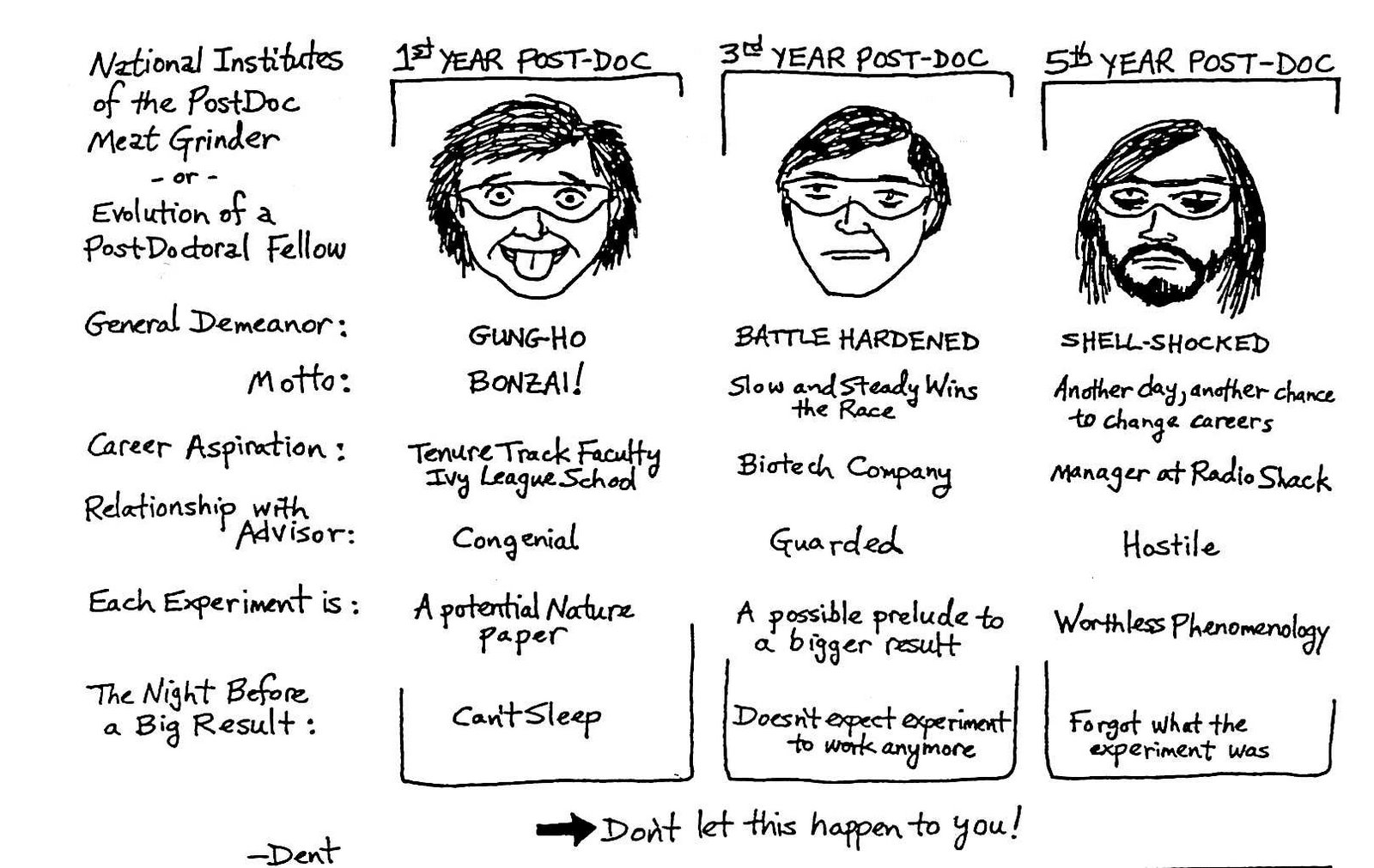
I’ve been thinking about my job lately. And my life. Or how to bring the two together more specifically. The “work-life balance”, as they call it nowadays. Looking around me I see young academics struggling to get their papers out, to find jobs, or to acquire research money. They work hard to make all that happen. The underlying assumption that keeps them going – that keeps us going – is the harder you work, the more rewarded you’ll get. Lately, however, I started doubting this assumption. In an academic world of scarcity it has become hard to succeed. Budget cuts, closing down of university positions, and a growing dependency on peer-reviewed journal publications and external research grants have created a bottleneck that is harder and harder to pass through. Not every ambitious scholar will make it, no matter how hard s/he works. Does that make me sound like a frustrated scholar? Yes, it does, but I share the frustration with the world. See what I found amongst the first results of the Google image search for “postdoc”:

Image credit: dentcartoons.blogspot.com

However, it also makes me a realistic researcher. And it opens up the chance to act upon that reality. Instead of sacrificing more and more bits of my life to the career, it made me think about life in and of itself. (What might be related to the fact that I’m growing older too, but that’s a whole different story). What is important in life? Why do I get up in the morning? What keeps me going? The job is certainly an important part in my life. I love my job. I love writing, going to conferences and sharing ideas with my fellows. I want to continue doing that. But not at any price. Look at this one, that was the second hit in the image search:

Image credit: scienceblogs.com/


Not if it requires working oneself to death, “writing like a madman”, as a colleague of mine put it once, and living in places I do not necessarily want to be – far away from my boyfriend, friends, and family. That may sound very naive, but it may also sound very healthy. I do think that my job should be organized around my life and not the other way round. Isn’t that interesting that the latter has become the standard practice though? That it has become normal to go wherever a job opens up or a fellowship is offered to you? – even if it’s just for one or two years? Without having the certainty – or even possibilty – to get a permanent position (ever)? That seems more and more insane to me.

That is why I try to focus on life from now on. What does that mean? I have no idea, but it feels great! And I’ll find out along the way, I guess. A good starting point for now is a sentence I’ve recently read on Norman T. White’s website. Below his name he says “celebrating 42 years without a full-time job”. (Further below he says “we fix toasters”).

In any case, I’ve met Norman a couple of weeks ago in Vienna. He is a well-known pioneer in robotics living in Toronto. He creates a lot of cool stuff including a “helpless robot”, a “sumo robot”, a tool for “arm wrestling over distance”, and many other “clearly pointless and useless” objects. I only met him briefly, but I perceived him as a creative thinker and a fun guy to have around. And he seems healthy and happy with life. That’s why I take him – and his anniversary – as a role model or spirit to follow. And everyone is welcome to join!