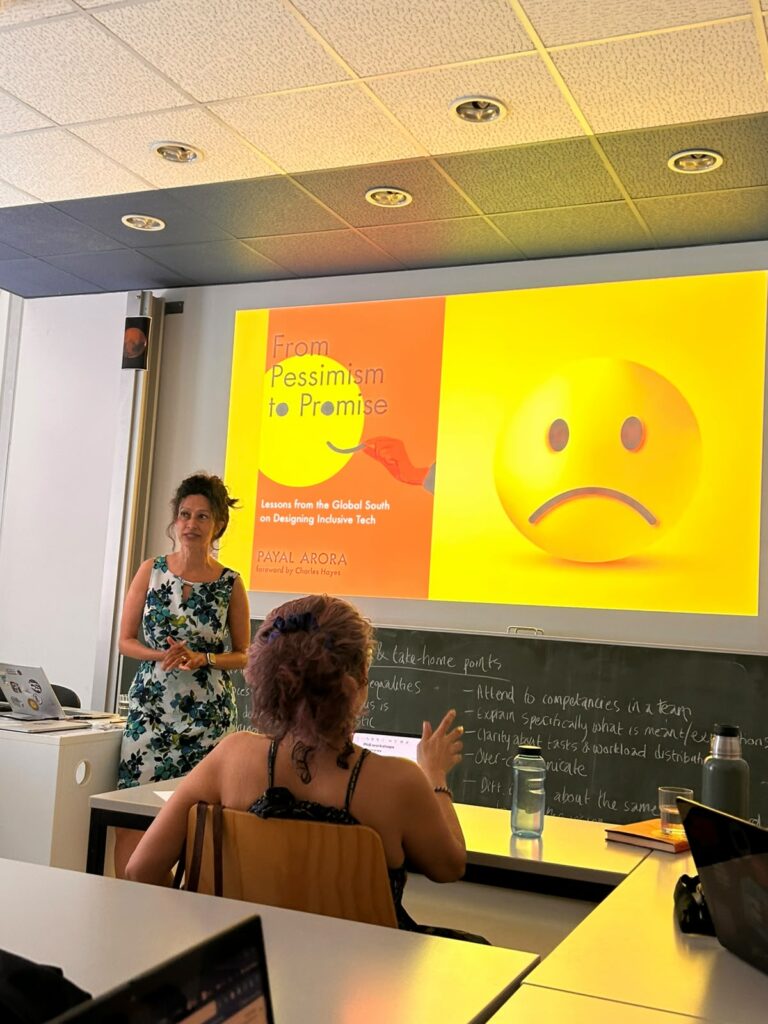
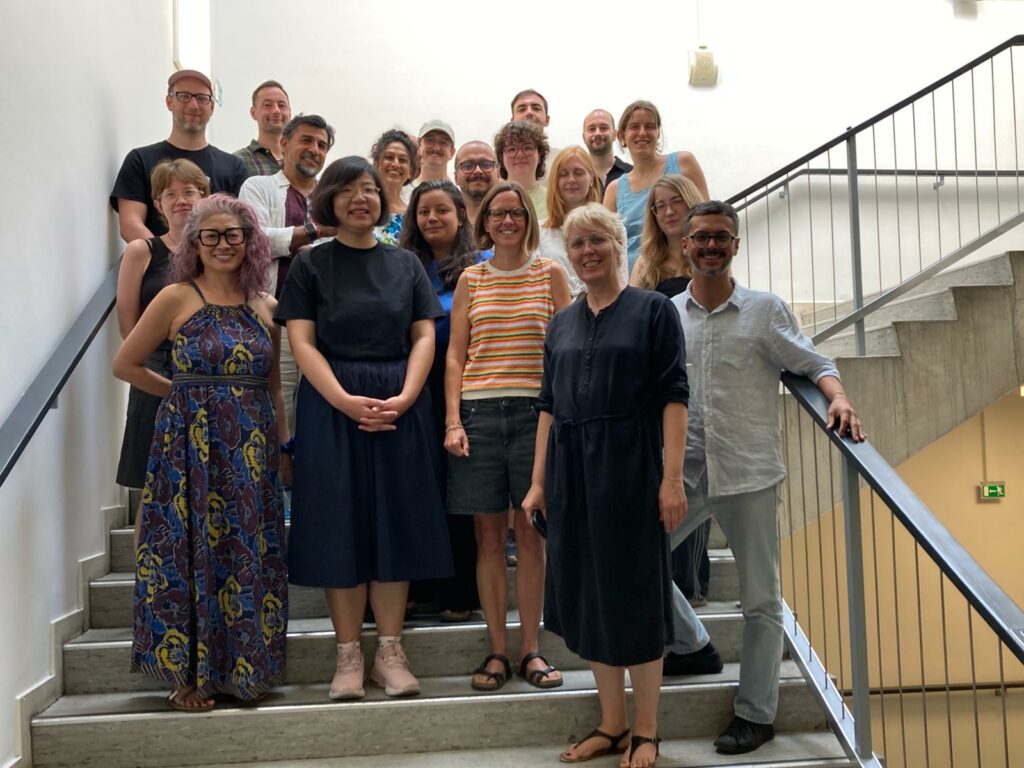
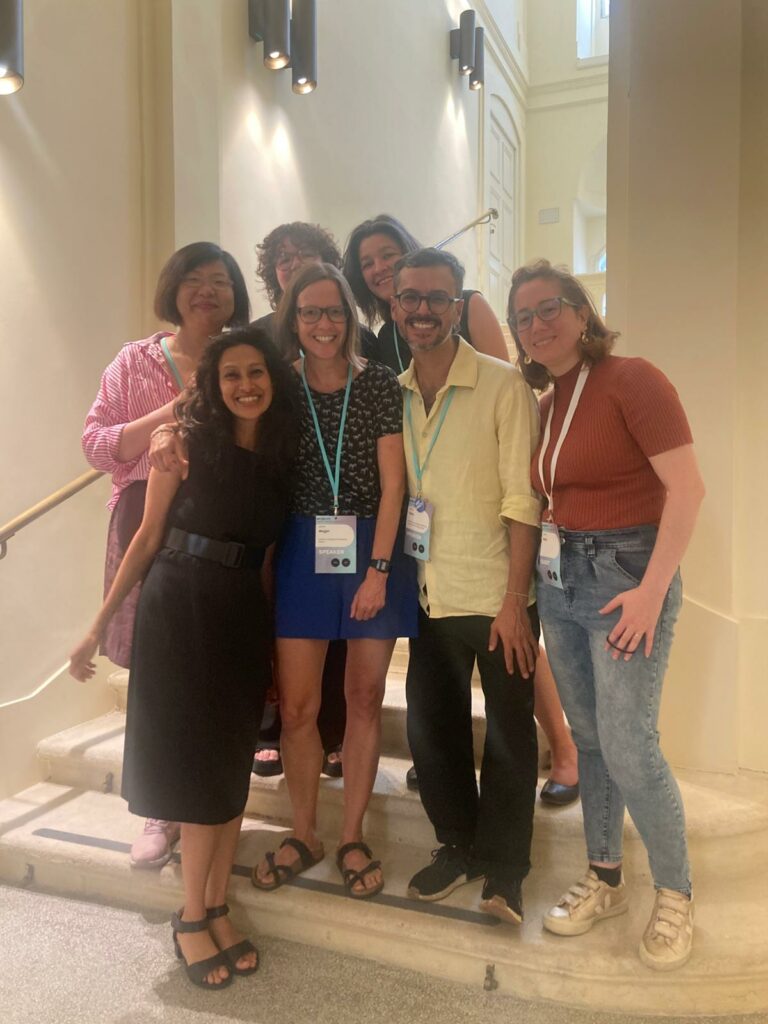
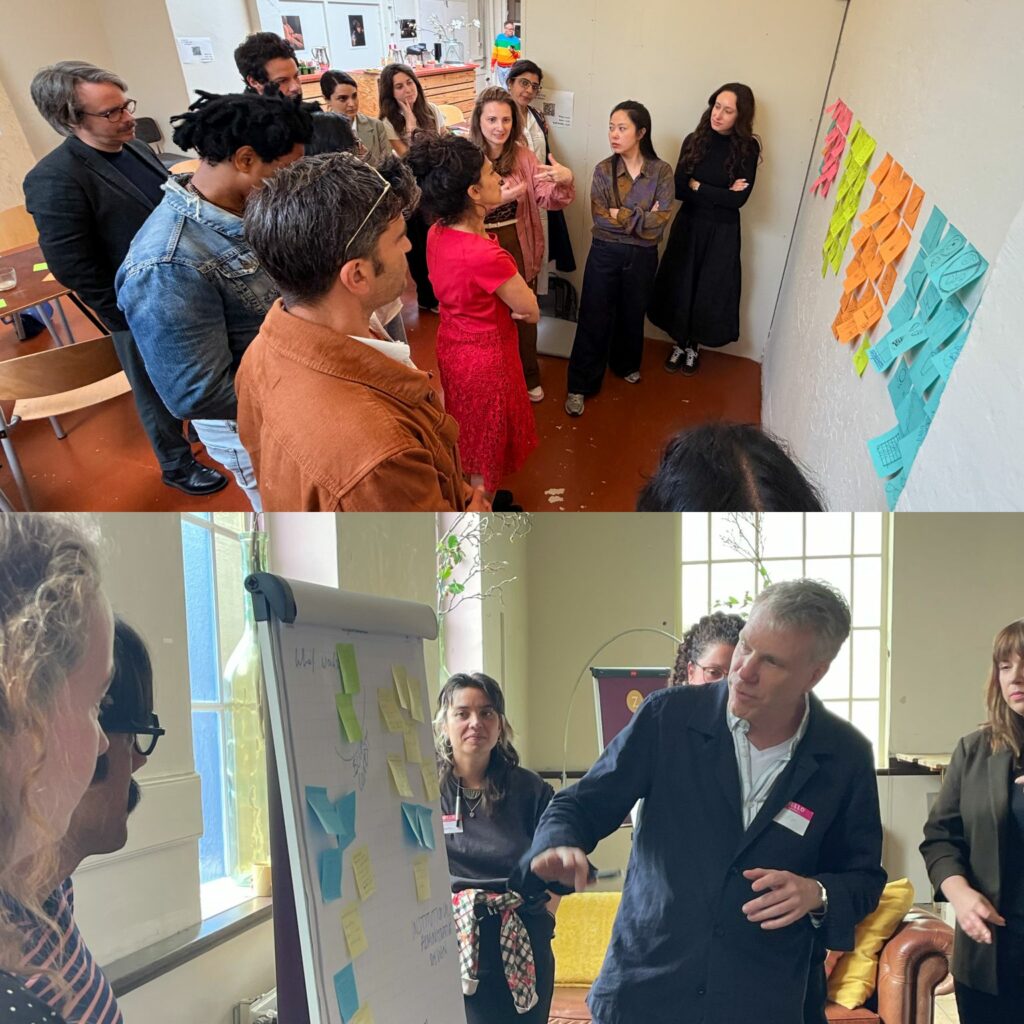
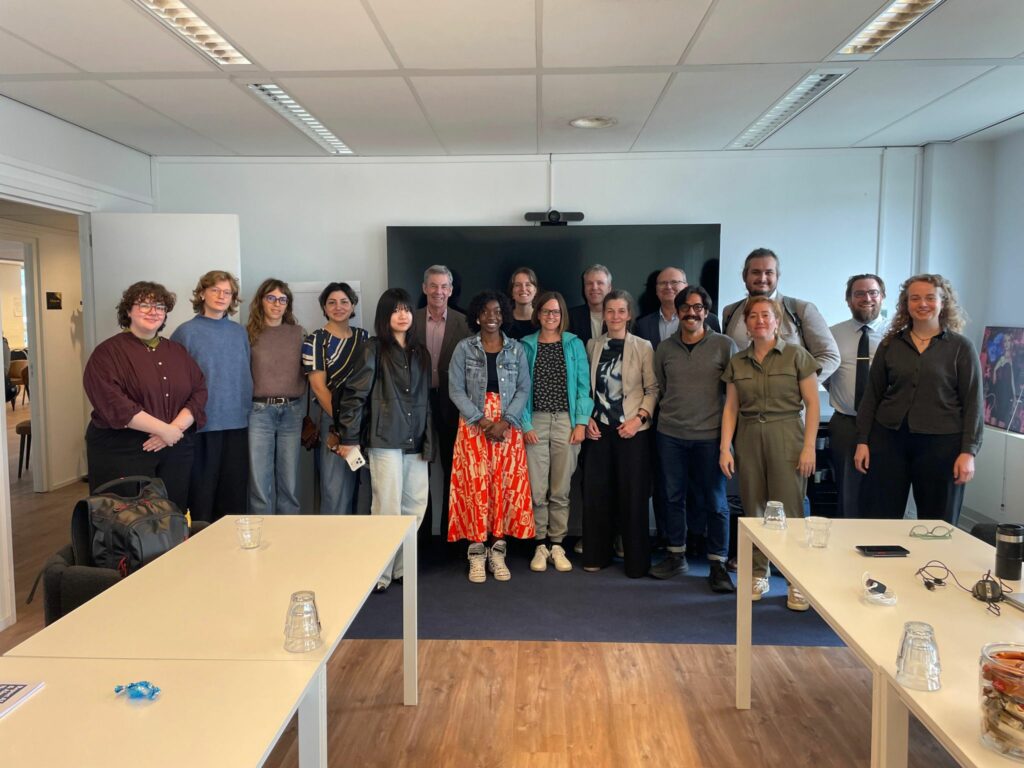
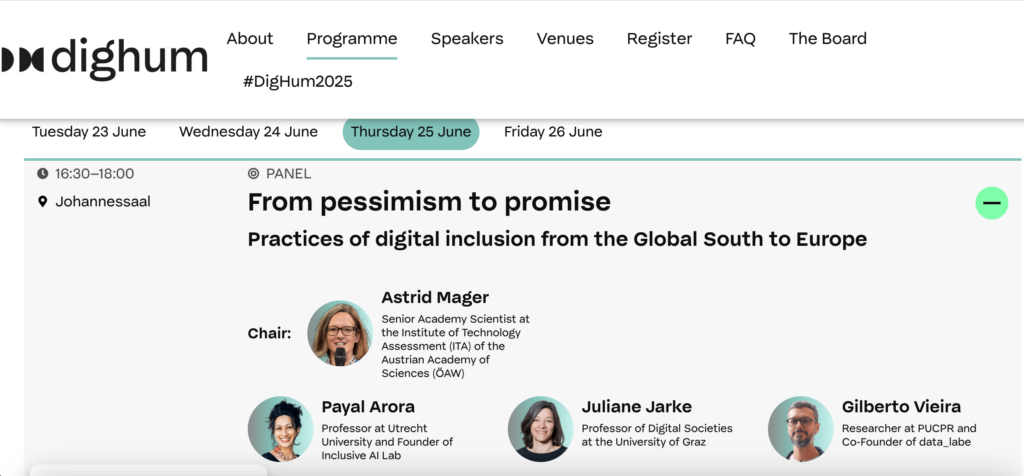
Thanks to all our contributors to the Digital Humanism session From Pessimism to Promise and the PhD workshop at the STS Department! And Katja Mayer, of course! The past days were really inspiring and thought provoking!! Let’s keep up the hopeful spirit! 🙂
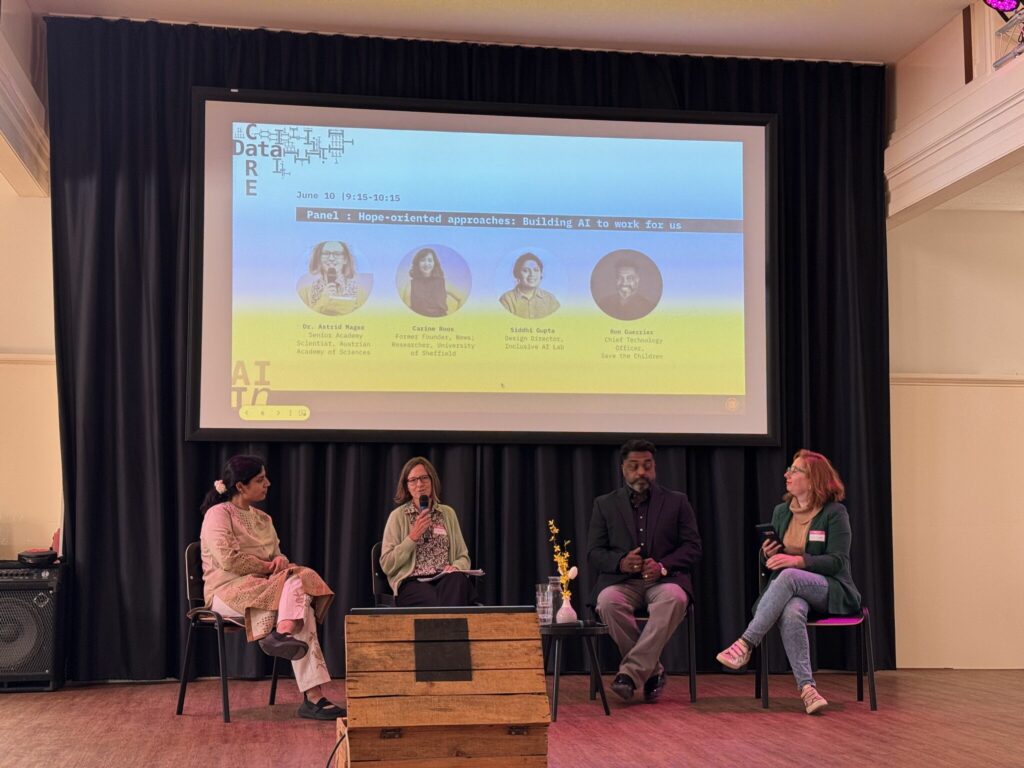
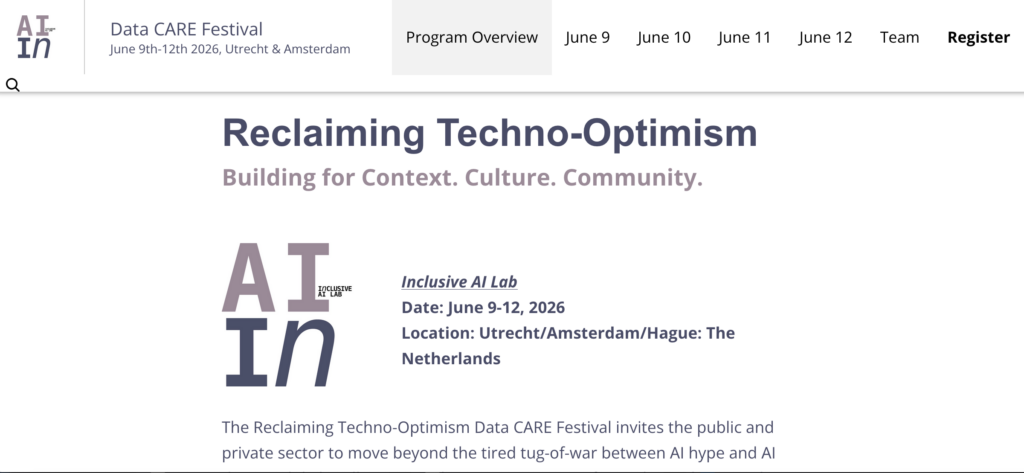
Last week, we had a great gathering organized by the fabulous Inclusive AI Lab, led by Payal Arora. The four-day event was part of the Data Care workshop series and had the motto – and aim – of Reclaiming Tech-Optimism. The Inclusive AI Lab, Utrecht University, follows the main purpose of opening up, diversifying, and reimagining AI together with the Majority world – which was reflected in the diverse set of speakers and audience – ranging from academic scholars, policy advisors, industry, to civil society from all over the world. The colorful exchange consisted of panel discussions, deep-dive workshops, field trips, and lots of interactive parts that made us get to know each other in ways we haven’t experienced so far (especially not in academic contexts) – such as introducing ourselves in ways we haven’t before, asking personal questions or staring in each others’ eyes for 2 (!) min without speaking, or talking to strangers on the street. Having been hesitant at first, I was ultimately surprised by the intimate connections we built and the hopeful vibes that were generated this way.
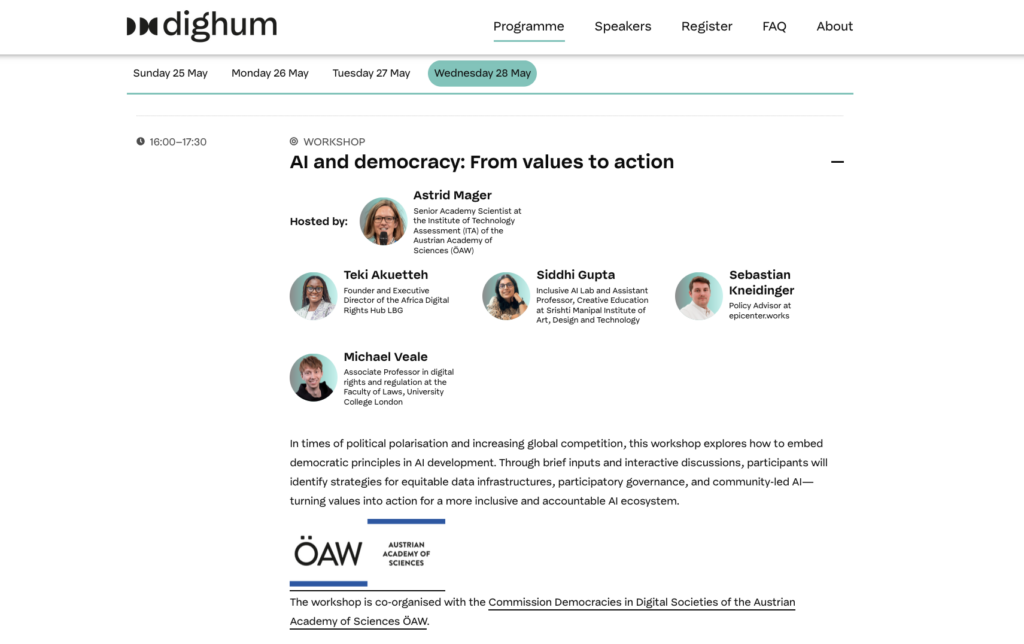
Together with Mirko Tobias Schäfer (Data School, Utrecht Univ.), and the support leads Rana Kuseyri and Constanze Kerres, I organized a workshop on “Situated AI Ethics: How to move from Values to Action” and a field trip to The Hague to visit the Data Protection Authority (DPA) and the Ministry of Labor and Social Affairs to talk about algorithmic systems in welfare states and how the Dutch Government responded to the Childcare Benefits Scandal more particularly (kindly supported by the ÖAW Commission Democracy in Digital Societies). The DPA’s professional and proactive take on algorithmic harm, risk mitigation, and human oversight gives me hope indeed! Two notions that particularly sticked with me were “institutional racism” and “institutional literacy”, which needs to be built on the very top of organizations rather than putting the burden on individuals such as citizens or civil servants. We’re currently collecting and organizing our ideas and planning to write a commentary or opinion piece based on the rich discussions we had – ideally together with some of the workshop participants and their wonderful examples of hopeful AI from different countries, cultures, and institutional contexts.
The spirit of hope – From Pessimism to Promise – will also guide our discussions next week that will take place as part of the Digital Humanism Conference in Vienna. First, Katja Mayer and I have organized a PhD workshop at the STS Department to discuss “Alternative Imaginaries of Social Digital Innovation from the Global South to Europe” together with Payal Arora and Gilberto Vieira from data_labe (Rio de Janeiro), as well as PhD students working on AI, policy, and human oversight in different institutional contexts. Second, we’ve organized a panel discussion with Payal, Gilberto, and Juliane Jarke to discuss how to reimagine and rebuild more inclusive digital futures – in Europe and the Global South(s).
I’m already looking forward to exciting days ahead!
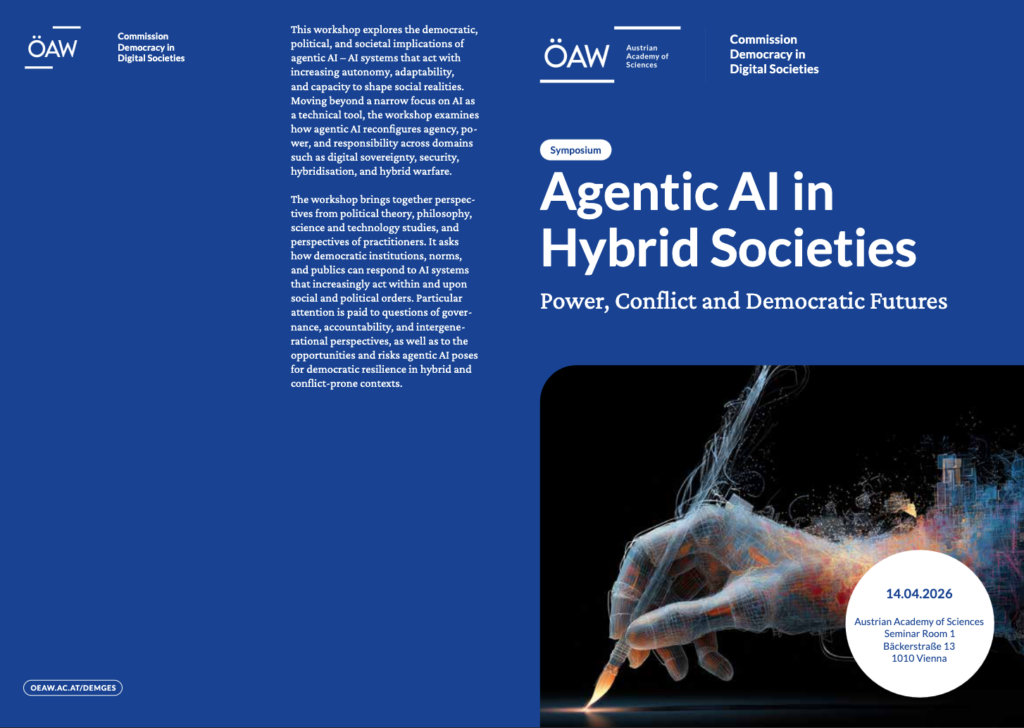
Next week, Barbara Prainsack and I will be holding a symposion on Agentic AI in Hybrid Societies at the Austrian Academy of Sciences (Democracy in Digital Societies; DEMGES). We’ve a fabulous line-up including young speakers from the Studienstiftung – who’ll bring in their perspectives on AI and societal challenges; a voice often overheard in public debate. Topics range from technical foundations of agentic AI, Europe’s digital sovereignty, global health governance, to autonomous warfare. The day closes with a future-oriented panel discussion. We’re looking forward to seeing you there! The full program can be found here.
From 9-12 June, I’m co-organizing a massive AI Festival in Utrecht/ Amsterdam; together with Payal Arora from the Inclusive AI Lab. The festival comprises hands-on workshops, field trips, creative sessions, and a PhD-led day. Together with Mirko Tobias Schäfer from the Data School (Utrecht Univ.), I’ll be leading a workshop on Situated Ethics: From values to action – asking how we could move beyond abstract ethics principles by learning from real-world experiences and expertise; particularly including policy makers, industry, and civil society from the Global South. On the next day, we’ll be moving behind the scenes of AI by visiting the Data Protection Authority and the Ministry of Labor and Social Affairs in The Hague. I’m really looking forward to peeking into the mundane practices of AI use and their – often unintended – side-effects ranging from data bias and discrimination to sociotechnical transformations of work routines – again asking how to practically respond to these developments on the government side; e.g. by creating “ethics officers”. The overall topic of the festival is Reclaiming Techno Optimism. (full program)
Finally, together with Katja Mayer, I’m currently putting together two sessions for the Digital Humanism Conference in Vienna (24-26 June 2026). One of them will feature Payal Arora and Gilberto Vieira from Rio de Janeiro (previously data_labe) – discussing how to move From Pessimism to Promise (Payal’s new book) and what we can learn from Global South perspectives and practices. The program will be out soon!
Please join us for the final conference of the AGIDE project (Academies for Global Innovation and Digital Ethics) at the Austrian Academy of Sciences: 27-28 June 2024 (in English):
In Austria, we’re diving through the “4th Corona wave” right now including a hard lockdown. Yet again, I’m sitting in my home (office) with the kids on my lap in case more than two school kids get infected in the same class. The responsibility has been fully shifted onto teachers, parents, and their kids by now. Politics has given up on the Covid-management of schools, as it seems. In the middle of this chaos, I’m enthusiastically thinking back to my (real!) trip to Lund two months ago. Olof Sundin and Alison Gerber invited me to give a keynote lecture at the interdisciplinary symposium In Search of Search (and its Engines). This workshop was a kind of gathering of pioneering search engine scholars that accompany me since my PhD (more than 15 years now). I finally met Elizabeth van Couvering, for example, whose work on the commercialization of Google and the creation of its business model based on the “traffic commodity” had a great impact on my PhD research. Also, Richard Rogers, Dirk Lewandowski, Jutta Haider, and other great scholars were there and it was FUN! (and not only because of the real food & drinks!) The best part is that we keep the lively debates about search engines, search engine research, and its academic & sociopolitical impact alive. We’re currently working on a special issue for Big Data & Society called The State of Google Critique and Intervention co-edited by Ov Cristian Norocel, Richard Rogers, and myself. We’re planning a workshop and a public event in Vienna (12 April 2022), which I love to organize in the middle of this 4th wave as a possibility to work towards a light at the end of the tunnel.. 😉 So stay tuned!
Tomorrow the huge 4S/EASST conference starts, albeit virtually. It’s the first ZOOM conference I’m attending at this scale and I’m really curious how that will work out! 😉 I’m involved in three sessions:
First, I’m contributing a paper on my alternative search engines research to the “grassroot innovation” session that nicely fits the scope of my paper. My first analysis of the YaCy/ SUSI.AI research materials is on visions/ politics of open source developer communities, their practices & politics, their relation to both the state and capital and how cultural differences play into all that – comparing Europe, Asia and the US. Here’s the link to the session.
Second, I’m involved in the session “building digital public sector” with our research on the “AMS algorithm” (together with Doris Allhutter, Florian Cech, Fabian Fischer & Gabriel Grill). We’re presenting a sociotechnical analysis of the algorithm and its biases & implications for social practices. Here’s the link to the session & here’s the link to our article for further information.
Finally, Christian Katzenbach and I have submitted a paper to the session “lost in the dreamscapes of modernity?” that covers the main arguments of our editorial to the special issue in NM&S on future imaginaries in the making and governing of digital technology (which is currently in press and will hopefully be published soon!). The editorial argues that sociotechnical imaginaries should not only be seen as monolithic, one-dimensional and policy-oriented, but also as multiple, contested and commodified; especially in the field of digital tech. Here’s the link to the session.
If you’re registered for the conference you can find the links to the ZOOM meetings right next to the sessions.
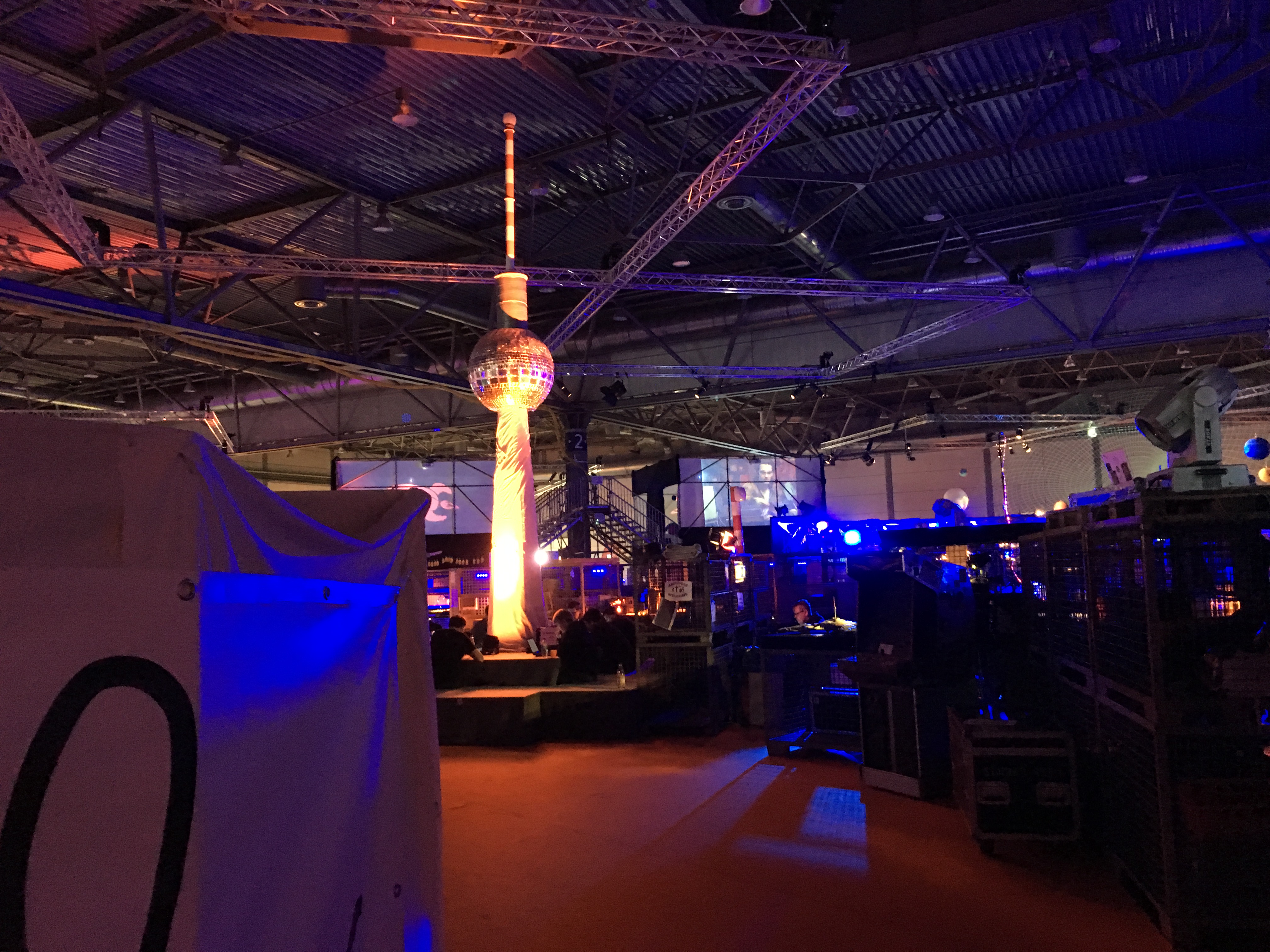
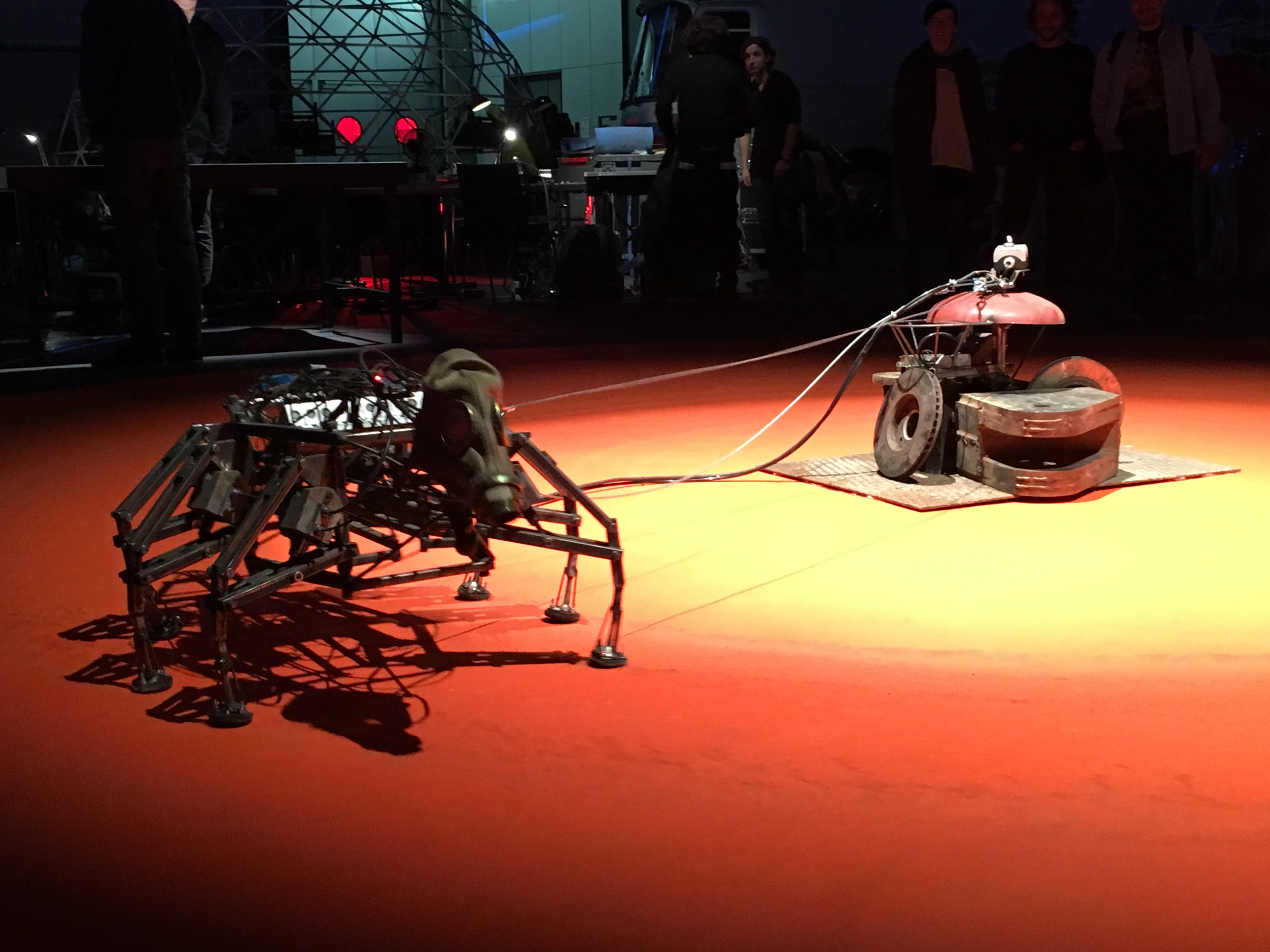
This year I had the pleasure to attend the 34C3 – Chaos Communication Congress – in Leipzig. Between Xmas and New Years Eve I gathered with 1500 (!) hackers, nerds and other great people in the Messe Leipzig, which is huge! Thanks to @toyear btw who sold one of his tickets; buying my own was impossible since there were only three particular dates for buying regular tickets and the contingent was sold out immediately.
The event was massive in all aspects. Large, glowing art works, huge assemblies of hacker communities, big speakers and wide audiences. I mainly attended to meet up with Michael Christen from the peer-to-peer search engine YaCy. Hanging out with him and Mario Behling – the two of them currently programming Susi.ai – was great fun! Altogether I got a really good insight in their work practices and the community at large. And: everyone was really friendly. Not fake friendly, I mean really friendly. And there were lots of kids too. To sum up, if you are interested in open tech, free software and hacking hardware that’s the place to go. Yes, the most useful thing I learnt there was lock picking!!
Tomorrow I’ll be going to the conference by the European Sociological Association in Athens. The conference theme is (Un)Making Europe. Capitalism, Solidarities, Subjectivities. I’ll be giving a talk on the co-production of search technology and a European identity in the session “information technologies & society” organized by Harald Rohracher. It’s related to my article “search engine imaginary” that got published in Social Studies of Science just recently. It’s pretty unusual for me to give a talk about finished work, but I thought I had to submit something since this research corresponds to the overall conference topic so well. 😉
(Un)Making Europe in the Context of Search Engine Policy
This article discusses the co-production of search technology and a European identity in the context of the EU data protection reform. The negotiations of the EU data protection legislation ran from 2012 until 2015 and resulted in a unified data protection legislation directly binding for all European member states. I employ a discourse analysis to examine EU policy documents and Austrian media materials related to the reform process. Using the concept ‘sociotechnical imaginary’, I show how a European imaginary of search engines is forming in the EU policy domain, how a European identity is constructed in the envisioned politics of control, and how national specificities contribute to the making and unmaking of a European identity. I discuss the roles that national technopolitical identities play in shaping both search technology and Europe, taking as an example Austria, a small country with a long history in data protection and a tradition of restrained technology politics.
I’m already looking forward to the AoIR (Association of Internet Researchers) conference in Berlin (6-8 October 2016). The overall theme of the conference is “Internet Rules!”. I’ll be part of the pre-conference workshop “The Internet Rules, But How? A Science and Technology Studies Take on Doing Internet Governance”; here‘s the program with its exciting line-up!! After one year of maternity leave this workshop will get me back on track.. hehe.