digital methods seminar

We (Katja Mayer and I) have just finalized our course on digital methods for next summer term. We’ll be teaching at the Department of Social Studies of Science, University of Vienna. The seminar will be part of the master program “Master of Arts – Science. Technology. Society”, but, in principle, everyone can join – if I understood it correctly. I’m not really familiar with the new curriculum yet though.. But I’m sure it will be fun since theoretical inquiry will be mixed with hands-on empirical research – fed by our own research and recent studies from our colleagues.

© image credit: Digital Methods Initiative (Amsterdam)

Here’s the syllabus. Join us if you like! Or otherwise, follow our seminar blog (which we plan to write if we find the time to do so 😉 )

Digital Methods – How Do We Know?

New information and communication technologies (ICTs) and social media like Google, Facebook and co. crucially change our daily lives. The “computational turn”, however, also affects the social sciences and humanities. Applications and software programs – ranging from simple presentation to complex network visualization tools – increasingly intrude into and shape scientific practices and the ways we conduct, present, and disseminate research. Rooted in the tradition of Science and Technology Studies (STS) this seminar addresses the central question of how digital methods of all kinds influence “how we know”. We will experiment with and critically examine various software tools and visualization techniques to better understand the growing number of digital methods used not only in the natural sciences, but increasingly also in the social sciences and humanities. We will ground these new tools respectively in older research traditions, discuss implications digital methods have in the process of knowledge production, and how to meet new challenges arising in the growing field of “digital social sciences and humanities”.

Drawing on literature from STS and critical new media studies, we aim to discuss the following questions: What are “digital methods” and what kind of knowledge(s) do they create? How do (digital) methods organize our research objects and what realities are enacted by them? How can hyperlink networks and Google analyses be used to analyze controversies like climate change or biofuels? How can social networking services, and Twitter in particular, be used to analyze political discourses and “hacktivist mobilization”? What information hierarchies and biases does commercial software trigger in the research process, and how can we handle this problem? What is “big data” and what are the benefits and dangers of large-scale computational science? And, finally, what are the implications of open access, creative commons, and Wikis in the context of both research and politics?

happy new year! –//– 2013 yay.


Technoscientific Promotion and Biofuel Policy

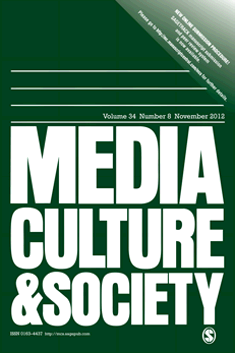
Jenny Eklöf and I have been collaborating on a project during my HUMlab fellowship (2010-2012). Our study investigated how the biofuel controversy plays out in the Swedish press and Google search results. The results will be published in the journal Media, Culture & Society (mid of next year). The exact phrasing of the editor goes like this:

“It will be several issues, and certainly several months, before your piece is prepared for publication and the proofs sent on to you. Please do not contact us for a specified issue number and date until 5 months or so after this note of acceptance.”

Well, if you don’t want to wait that long please let us know and we’ll send you a copy!

That’s the abstract:

What are the conditions for the public understanding of biofuels and how do the media shape these conditions under the influence of a new production of knowledge? This article investigates how the biofuel controversy plays out in the Swedish press and Google search engine results and analyses winners and losers in the tight attention economy of contemporary media. It describes different visibility strategies biofuel stakeholders employ in both media arenas, and identifies a form of technoscientific promotion that hybrid actors use to succeed in the day-to- day struggle for media attention. To conclude, it raises broader societal questions of the contemporary blurring of knowledge boundaries and the emergence of new information hierarchies and their biases. By understanding how contemporary media shape controversies, we can address the democratic potential of both mass media and science.

liam

celebrates his first week on earth!!! 🙂


finally!

After two (!) years my last PhD-related article just went online! It’s been published by the popular online journal First Monday, which is – normally – known for a quick review process. But well, good things take time, as the saying goes. Since my PhD “Mediated Knowledge” (download here) deals with the computer-mediated communication of online health information you may ask whether the article is not outdated by now. That’s what I was asking myself, at any rate..

But the answer is no. Even though the empirical data may seem quite “old”, and Web 2.0 health communication has become more widespread in the meanwhile, the base line of my arguments – the “politics of online health information” challenging the democratic ideal of the web – is still valid and more relevant than ever (not least because Google managed to further enlarge its market share and hence influence over online knowledge since then). Got interested? Then check out my article “Health information politics: Reconsidering the democratic ideal of the Web as a source of medical knowledge” on First Monday and decide for yourself!

Thanks go to my HUMlab colleagues for their helpful comments on earlier drafts of the paper, Mike Frangos first and foremost!!!

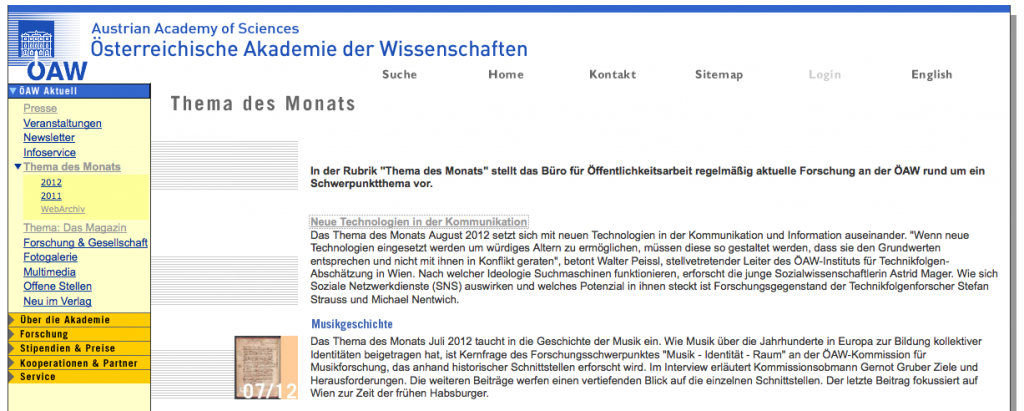
ÖAW topic of the month: ICTs

Each month the Austrian Academy of Sciences defines and discusses a “topic of the month”. The current issue deals with new communication technologies and presents three ITA projects. Besides my own project “Glocal Search“, the EU projects “Value Ageing” and “European Perspectives on Cloud Computing and Social Networks” are featured. The ÖAW portraits of the projects can be found online or in the paper magazine “Thema Forschung” (October). Enjoy reading!

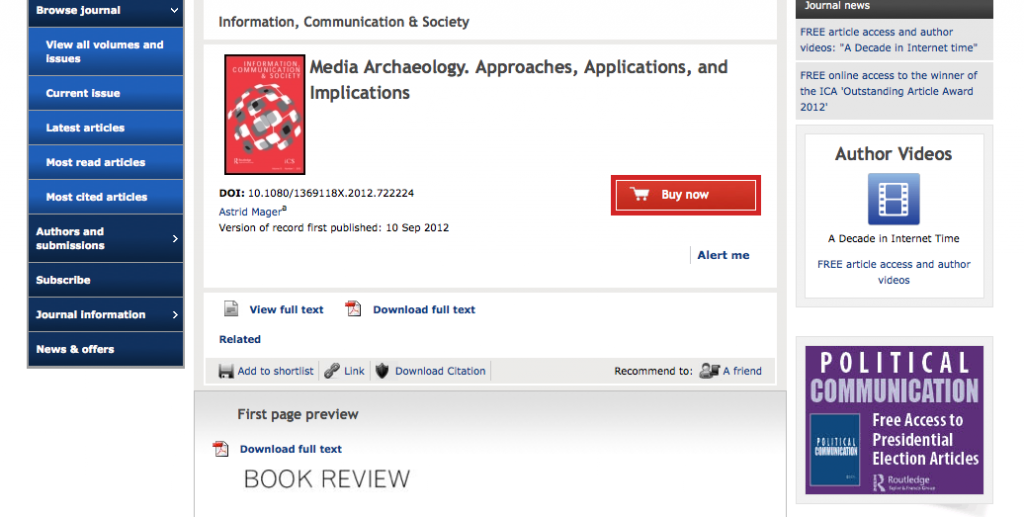
book review online

My book review “Media Archaeology. Approaches, Applications, and Implications” (eds. Erkki Huhtamo and Jussi Parikka) has been published by the journal Information, Communication & Society (see below). Thanks to David Beer for the really quick publication process! It was fun!

Please let me know if you can’t access the journal!

the next B-I-G project :)


Book review “media archaeology”

I’m happy to announce that my review of the book “Media Archaeology. Approaches, Applications, and Implications“, edited by Errki Huhtamo & Jussi Parikka, will be published in a forthcoming issue of Information, Communication & Society! It is my first book review and it was really fun writing it. Given that I thought a humanities scholar would have been a better fit at first sight, the book turned out to be really relevant for social scientists/ Internet researchers. It’s a good read for everyone interested in “new” media and their “old” predecessors. So stay tuned!


Pics & press coverage from APA eBusiness event

Last week we had a very lively discussion on new media – search engines and facebook – and privacy (see blog post below). Central questions were how these new online services use personal data to create profit, what privacy violations that involves, and how to meet these challenges with (EU) regulations and strategies of digital self-defense. It was a highly diverse, but really interesting combination of people on the round table including Johannes Juranek (CMS), Helmut Waitzer (Navax), Max Schrems (Initiative “Europa gegen Facebook”) und Markus Deutsch (WKO) and me.

© photo credit: APA-Fotoservice/Rossboth

Check out the fotos & press coverage (e.g. APA Science & futurezone) of the event for more information!