it’s the network, stupid

Yesterday I was on a panel discussion on surveillance organized by quintessenz and emergence of projects. It was a lively discussion, which left me with more open questions than answers though. Reinhard Kreissl (sociologist of law and criminology) and Markus Kainz (quintessenz, moderator) easily agreed on the bad guys (usual suspects like the state, government, Google, Billa) and identified civic disobedience as an appropriate way to fight surveillance. Practical examples of such guerilla activities were swopping Billa Vorteilscards or defrauding the population census (by reproducing sheets and feeding them with wrong data). Even though I like the idea of creating a critical mass of disobedient citizens to mess with statistics, I think it’s not that easy anymore in times of digital surveillance. Cheating with sheets of paper and swopping discount cards is easy compared to messing with big data and algorithmic logics. The reasons for that are multiple:

First, digital surveillance is almost seamless. As Markus put it: “We are surveilled not once or twice, but various times”. Combinations of data from cell phones, surveillance cameras, credit cards, and digital tools like search engines and social networks make it hard to escape from your own data body. The data points we leave are simply too many and too heterogeneous. Here, I agree with Manfred Kreissl: “We are leaky containers”.

Second, most individuals do not have the knowledge and technical know-how to mess with such complex digital networks. And why should they? Most people, the majority, most probably, is pretty happy with how things are. They get discounts with their Billa card, they get free – and pretty good – online services from Google & co, they have become used to or even grew up with extensive surveillance and advertising so that they don’t care anymore. That does not necessarily mean that people agree with all these data collections, it just shows that people take on a pretty fatalistic attitude in their daily lives. And yes, some people don’t care at all or simply like contemporary consumer culture – just like one of my interviewees, working in human design and engineering, phrased it: “I think the driving force behind this information economy is our, kind of, probably, possibly a little bit unhealthy desire to just keep consuming, and communicating, and producing at such a frenzy rate.” (Mager 2012: 10)

And, finally, even if people are discontent with the current surveillance state, why should it be the responsibility of the individual to fight a system that even politics and regulations seem to face with powerlessness? And how could we even step out of these powerful networks of surveillance? A quote by Scott Lash came to my mind when cycling home from the discussion: “The point that this book has tried to make is that we can no longer step outside of the global communication flows to find a solid fulcrum for critique. There is no more outside. The critique of information is in the information itself.” (Lash 2002: 220). Lash’s Critique of Information may be seen as an explanation for the digitization of political action. Even politics has become a matter of mouse clicks. Signing an online petition, liking a political group, sharing a critical initiative, all that is political engagement these days. The good thing though, and I think that’s something we should not forget, is that also new social movements are emerging from these activities, Occupy Wall Street, the Arab Spring (whether successful in the end or not), or Uni Brennt have (also) been organized online and have ended on the streets.

So what I’m trying to say, I guess, is that things are more complicated than they seem at first sight. Of course, surveillance states, Google, Billa and other players are spying on us and (ab)using our data and that’s bad. No doubt about that. Blaming them, however, is not enough in my view. Rather, it’s important to understand power relations and dynamics that are stabilizing them. Political decisions, media debates, but also our own behavior that is essentially feeding their power. Only then proper ways out may be found. Ways out that may even be digital. Times have changed since 1968 and so have we.

image © http://commons.wikimedia.org
Lash, Scott (2002) Critique of Information, London: SAGE
Mager, Astrid (2012) Algorithmic Ideology. How capitalist society shapes search engines, Information, Communication & Society, 1-19

talk talk talk

In the upcoming weeks I’ll be talking a lot 😉 First, I’ll be part of a discussion on surveillance – “WIR: DER SOUVERÄN” organized by the Emergence of Projects and Quintessenz (11 September, Künstlerhaus Passagegalerie). Second, I’ll participate in the presentation of the demands the net politics convent formulated for Austrian politicians. That’s gonna take place at the conference Daten. Netz. Politik 13 (14-15 September, Kabelwerk). Finally, the next day, I’ll talk about “Mächtige Netze – Vernetzte Macht” at the Paraflows Festival (13-15 September, MQ).

All events are taking place in Vienna.

The abstract on Mächtige Netze – Vernetzte Macht reads like this:

Google, Facebook, Amazon & co. Sie alle haben sich geschickt in Stellung gebracht. Die offene Struktur des Netzes durch geheime Algorithmen, digitale Zäune, und Werbenetzwerke beschnitten und dem Konsum ausgeliefert. Sie sind zentrale Knoten in einem dezentralen Netzwerk. Mächtige Player in einem per se machtfreien Raum. Doch ihre Macht ist nur geliehene Macht. Sie ist Produkt unserer Vernetzung. Unserer Gier nach Aufmerksamkeit, Zuspruch, Klicks und Likes. Ihre Macht ist ein Netzwerkeffekt, wie ich vor dem Hintergrund der Akteurs-Netzwerk Theorie diskutieren möchte. Doch was passiert wenn wir uns ausloggen aus dem System? Ausklinken aus dem mächtigen Netzwerk?

Search, share, shop

That’s gonna be my next seminar @ the Department of Science & Technology Studies, Vienna, winter term 2013/14. I’m already looking forward to interesting discussions! 🙂

Search, share, shop. Critically examining the internet as technology, medium and social practice

The internet has often been described in utopian or dystopian terms if we think of the Twitter revolution in the Arab Spring or the narrative of Google making us stupid. Both of these blunt examples illustrate techno-deterministic viewpoints that often accompany the internet in public and academic discourses. This seminar aims to challenge these viewpoints by conceptualizing search tools, social media and wikis not as external to society, but rather as enacted in society and hence mirroring social, political and economic values and ideas. ‘Technology is society made durable’ as Bruno Latour put it straightforwardly. At the same time, however, Google, Facebook and co. also materialize and hence solidify societal values, politics and ideologies. They may be seen as shaped by society, while at the same time shaping society.

The task of this seminar is to critically examine the web as technology, medium and social practice. Using literature and analytical concepts from STS and critical new media studies we will address the following questions: What values, politics and ideologies do technological tools like the PageRank algorithm embody and how do they get inscribed in their technical Gestalt? In what ways may search tools and social media be seen as ‘acting’ in terms of shaping user practices? How do Wikileaks and Twitter challenge classical politics and what are the features of the arising ‘networked news ecology’? How do open access, Wikipedia and social networks like Academia.edu affect and transform practices of knowledge production and dissemination? What are the business models of Google, Facebook and Amazon, how do users contribute to the ‘like economy’, and what consequences does this trigger in regard to the exploitation of digital labor and user data? And, finally, what classical and new methods may be used to study digital phenomena of all sorts?

To answer the above mentioned questions theoretical discussions will be mixed with empirical work, which will lead to a small research project each student will conduct in the seminar paper.

More information on dates, time etc. here.

become a data dealer

This is a great project! The online game DATA DEALER playfully deals with practices of user profiling, sellout of private data, privacy violations etc companies like Google, Facebook, and other for-profit IT companies raise with their advertising-based business models. In the article Algorithmic Ideology I’ve shwon that the power of search engines (and social media platforms, &&&) is enacted and stabilized in a complex network of actors and social practices. I’ve argued that it’s not enough to blame Google (and other companies) for making profit and having gained a quasi-monopolist position on the internet . Rather, it’s important to understand how various actors including programmers and advertisers, but also policy makers, journalists, jurists – and last but not least – users help to stabilize its powerful role by simply using their services and contributing their data to the sophisticated caplitalist accumulation cycle. Accordingly, critically examining and debating business models and practices of Google, Facebook & co is a valuable first step on the long road towards a better understanding of new media services and, ultimately, a change of existing and future practices, products and privacy settings. The reform of the EU data protection law, for example, is a long and tough negotiation process! Playing, supporting, and sharing DATA DEALER, on the contrary, is a quick move enabling us to think about and raise awareness on the matter. And it is fun too!

If you wanna join the undertaking, go to their website, watch their video trailer, install the demo version or donate money. They’ve managed to raise $50 000 via crowdfunding just recently. I’m sure they’ll manage to create an awesome – non-profit (!) – online game! Good luck!!!

net politics convent

Before I took off to Greece (two weeks of internet absence – yay!!!) I participated in a net politics convent of the Austrian civil society organized by the World-Information Institute, Vienna (participants from activist groups, research institutes, arts & culture, technology experts, engaged citizens; supported by servus.at). The primary aim of the gathering was to formulate claims in the context of net neutrality, data protection and privacy rights, open data and open knowledge and, finally, copyright. The claims are directed to Austrian politics. The time is right now since all parties have started campaigning for the elections in fall. Net political issues should be part of their strategy! And there is much to discuss as the vivid debates at the convent have shown! It was not easy, but we finally came up with three straight claims per issue that are summarized below (in German). For more in-depth information on and discussion of these claims go to the convent’s website. If you wanna support our claims, please sign the petition here and share it widely – via Facebook, Twitter or old-fashioned email and word of mouth!

Netzneutralität

  • Gleiches Internet für alle!
  • Das Netz muss öffentlicher Raum sein!
  • Keine Überholspur für Großkonzerne!

Datenschutz und Recht auf Privatsphäre

  • Privacy by Design!
  • Durchsetzungsfähige Behörde für Informationsfreiheit und Datenschutz!
  • Entbündelung von Datenmonopolen!

Offene Daten und Offenes Wissen

  • Transparenzgesetz und Öffnung der Datenbestände des öffentlichen Sektors!
  • Freier Zugang zu wissenschaftlicher Forschung und Produktionen aus öffentlichen Mitteln!
  • Freie Verfügbarkeit von Lehr- und Lern-Unterlagen öffentlicher Einrichtungen!

UrheberInnenrecht

  • Ausweitung der freien Werknutzung (z.B. Remix) bei entsprechender Vergütung!
  • Stärkung der Position der AutorInnen durch UrheberInnenvertragsrecht!
  • Kürzere Schutzdauer, mit Verlängerungsmöglichkeit durch UrheberInnen!

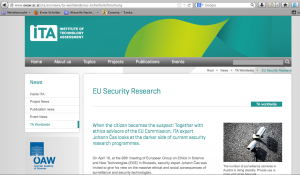
ita 2.0

Just recently the Institute of Technology Assessment Vienna (ITA) relaunched its website. Along with the new Website it entered the so-called Web 2.0 including Twitter & Facebook. Having followed ITA’s way into social media, I realized that creating an institutional Web presence is not as easy as writing an individual blog. Questions popped up that I never thought about when writing my own stuff: Who is speaking in the name of ITA? What philosophy, political stance  or “Blattlinie” is followed? How much interaction is wanted? AND – last but not least – who is maintaining all these new media arenas and filling them with content, news and “updates”? Just like classical PR social media maintenance is a lot of work and needs to be done on top of everything else..

Despite all these challenging questions ITA has managed to appear in this “networked news ecology” (Felix Stalder) – co-performed by human and algorithmic practices. If you’re interested in the growing role technology – ranging from digital media, surveillance cameras, nano technology, smart grids to synthetic biology – plays in science and society I recommend following ITA news on its website, as well as ITA updates on Twitter and Facebook. I’m sure you’ll LIKE it!!!

society of the query

I’m happy to announce that the Institute of Network Cultures will be hosting another Society of the Query event in Amsterdam, November 7-8 2013. I’m even happier that they asked me to present some of my search engine work there 🙂

For those who haven’t heard of the Society of the Query events yet, I recommend their collaborative research blog on search. The blog was originally initiated in the course of various search engine events including Society of the Query 1, Amsterdam 2009, and the Deep Search conferences in Vienna, 2008 & 2010. It was – just recently – re-activated by René König, who was also involved in the conference planning. Thanks René, I hope to see you in Amsterdam!

vor google

On the 9th of April the book “Vor Google. Eine Mediengeschichte der Suchmaschine im analogen Zeitalter” will be presented and discussed in the Wienbibliothek im Rathaus (in German). The book is edited by Thomas Brandstetter, Thomas Hübel & Anton Tantner and contains a number of essays on “analogue search engines” including bible citation indexes, state calendars of the 18th century and their hierarchical system, newspaper comptoirs, servants as crucial information centers, Vannevar Bush’s Memex and the politics of bibliometrics.

Since I’ll be giving a short review of the book and participate in the round table discussion (along with Jana Herwig and Stefan Zahlmann) I’m currently reading through the book.
The impression I immediately got while flipping through the pages is that thinking about search engines and their predecessors from a historic angle adds great value to common search engine research. Some of the past issues – e.g. how to organize indexes, the politics of search – still haunt present-day search tools, while others have only recently been introduced – e.g. the commercial dimension of search engines and the exploitation of user data. All in all there’s much to learn from juxtaposing contemporary and past search engines!

If you wanna participate in this exciting endevour please join us on the 9th of April, 7pm, Lesesaal der Wienbibliothek im Rathaus, Eingang Lichtenfelsgasse 2, Stiege 6 (Lift), 1. Stock, 1010 Wien. (= sounds complicated, but will hopefully be doable 😉 )

Here’s the book outline from the Wienbibliothek Website, where you can find more information:

Ein Alltag ohne digitale Suchmaschinen ist heute nur noch schwer vorstellbar. Dabei lassen sich zahlreiche Einrichtungen, Personen und Techniken ausmachen, die lange vor Google und Co ähnliche Funktionen übernommen haben – Staatshandbücher und Diener etwa, aber auch Bibliothekskataloge, Fragebögen oder Zeitungskomptoire. Welche strukturellen Ähnlichkeiten gibt es zwischen diesen früheren und den heutigen Suchmaschinen? Welche Utopien knüpften sich an die Suchmaschinen des analogen Zeitalters? Welche Formen von Kontrolle ermöglichten sie? Das vorgestellte Buch widmet sich diesen und weiteren Fragen und liefert damit nicht nur neue Erkenntnisse über die Medien der Vergangenheit, sondern vertieft auch die Analysen der gegenwärtigen medialen Lage.

momentum 13

I’ve been invited to moderate the track “technology and regulation” at the Momentum 13 symposium. I’ve never heard of this conference before, but it seems to be an exciting platform for political discourse concerning societal challenges of all sorts. Its panelists include scientists, policy makers, activists and labor unionists. This year’s topic is “progress” in its broadest sense. The abstract on their website reads like this:

The conference-series “Momentum” is dedicated to the integration of academic knowledge and political practice and invites contributions from researchers, labor unionists, political practitioners and activists. Momentum is interdisciplinary, particularly open to submissions from young scholars and decidedly invites not only academic but also policy-oriented papers. The Momentum conference series has been launched in 2008 and is held in German (although English contributions are also welcome).

The call for papers is open until the 19th of April 2013, the deadline for finalized papers is the 7th September. An overview of the ten thematically distinct tracks (democracy, economy, art, social movements, technology, feminism and more) may be found here. The symposium is led by Barbara Blaha, Josef Weidenholzer and their team. The location Hallstatt is scenic, as these pics show.

Would be fun to see you there!


europe vs facebook/ Ö1: 10.02.; 22:30pm

Here’s the link to the upcoming radio broadcast dealing with the student initiative “europe vs facebook”. Since I gave an interview for the program, along with other “experts”, the broadcast will most likely contain one or two of my sentences 🙂 It will go on air on Sunday, 10.02., at 22:30 pm; radio station Ö1. Or, alternatively, you could also follow the program online. I’m not sure if there’ll be a podcast available right after, but if so I’ll post the link. You’ll find more information on the program here.